Table of Contents
Ad fraud has become a major problem for affiliate marketers, draining ad budgets at scale. This scam caused over $84 billion in losses globally in 2025. For brands, the issue is not only an economic drain. Small businesses are becoming the hardest-hit victims of this digital deception.
Fake ads generate extra traffic by mimicking genuine clicks, poisoning your analytical foundation. Without clean data, marketers unknowingly scale failing channels and miss genuine growth opportunities.
Analyzing verified ad fraud statistics allows you to isolate inflated metrics and identify specific threats targeting your niche. This intelligence shifts your strategy from reactive fixes to proactive, data-driven defense, ensuring your budget supports real human engagement.
Ad Fraud Overview: Why These Statistics Matter
Now that we are in 2026, digital ad scammers are actively leveraging AI to generate fraudulent ads. The ecosystem is too contaminated to run a healthy campaign. Understanding industry-specific fraud patterns reveals where to take targeted action and how to adjust your advertising strategy to protect ROI.
The Current State of Digital Ad Fraud
FraudScore's recent report revealed that, in 2025, 47.4% of globally analyzed traffic was generated by fraudulent ads. Back in 2024, the percentage was around 40.76%.
Meanwhile, 20.64% of the global traffic was detected as invalid throughout 2025. These fake campaigns snatched more than 105.7 billion impressions away.
Undoubtedly, the risk is now higher than in previous years. AI-powered bots are making it more complex to determine them. This issue between ad fraud and phishing ecosystems is not accidental. The same bot networks driving fake clicks also power mass malicious email campaigns.
In 2025, Gmail users reported a 30.1% rate of malicious emails, signaling an alarming situation for businesses.
Before launching a campaign, a marketer typically analyzes past ad data. To get genuine results, a seasoned marketer applies several filtering measures. They rely on statistics to measure the actual performance of their campaigns.
- Identifying wasted spend: As of 2026, approximately 8.51% of paid ads globally are considered invalid. Advertisers can pinpoint the range and differentiate easily between what sites are ad-friendly and what are not.
- Benchmarking campaign performance: These statistics allow us to measure a normal CTR benchmark. Fraudulent ads cause "fluff" campaign data so that the outcome looks higher. It's a common trick they use to hide bounce rates.
- Fraud prevention strategy: Most importantly, fraud reports help you identify which specific types of misleading ads are causing your losses. Scammers follow different strategies for different industries.
What Is Ad Fraud? Key Facts Businesses Should Know
Ad fraud refers to misleading or deceptive advertising activities. The goal is to manipulate users into engaging with the ad. This unwanted attention appears as a genuine action. Advertising platforms pay and value according to the impressions and conversion volume.
As a result, marketers invest in better exposure, but a significant budget is wasted on these scams.
What is IVT?
IVT, also known as Invalid Traffic. It refers to any ad activity such as clicks or impressions that does not come from a real human being with genuine interest.
Industry standards divide IVT into two categories:
General Invalid Traffic (GIVT)
This includes non-malicious automated traffic from search engine crawlers, bots and data centers. Most standard analytics tools identify and filter GIVT easily because it does not attempt to mimic human behavior.
Sophisticated Invalid Traffic (SIVT)
This is the malicious core of ad fraud. SIVT consists of bots, hijacked devices, and click farms specifically engineered to bypass detection. Also, it generally relies on IP Spoofing. SIVT also consists of malware-driven fraud that mimics human behavior to generate fraudulent traffic, making bot activity difficult to differentiate from real visitors.
Identifying the ratio of SIVT within your ad fraud statistics is essential for protecting ROI. Failure to filter this traffic leads to skewed performance metrics and the misallocation of spend toward fraudulent channels.
Here’s a table highlighting the technical differences that impact your ad fraud statistics.
Most Common Types of Ad Fraud
- Click fraud: To show a large volume of clicks, spammers use automated scripts, individuals, or bots.Bots and hired clickers, with no intention of making a purchase, are designed to mimic genuine human behavior. The goal is to exhaust the advertiser’s budget.
- Impression fraud: Fraudsters use hidden ad techniques to generate fake impressions and bill advertisers for views that never happened. This mostly happens in CPM-based ads.
- Domain spoofing: Spammers build a replica website mimicking a known brand's website or email domain to deceive users into clicking. Fraudulent misdirection ads lead to low-quality sites, whereas advertisers intend to place ads on trusted sites. This often appears as a genuine ad. Marketers get misled and continue funding when they see their ads are running.
- Ad stacking: Scammers typically use CSS or an iframe to place multiple ads behind one legitimate ad. When a user clicks on the genuine ad, the website automatically registers clicks on those ads too. It creates fake impressions. Advertisers keep spending on impressions yet see very low conversions.
- Conversion Fraud: AI-driven bots complete specific actions such as form submissions, app installs, or newsletter sign-ups to trigger a payout. By mimicking high-quality leads, scammers deceive advertisers into paying for worthless conversions that never result in actual sales.
The Role of Bots in Digital Ad Fraud
- The “Agentic AI" bots can infiltrate complex funnels, mimicking human customer activity. This new type of bot saw 7,851% year-over-year growth in 2025.
- 51% of total web traffic now comes from bots.
- Traditional IP-based blocking systems can't detect 80% of AI bots. AI agents use residential proxies that successfully bypass filters as real users.
- Bad bots contaminated 37% of all internet traffic.
AI and Automation in Ad Fraud
- According to recent reports, the travel, retail/e-commerce, and media industries are the primary targets of AI-driven advertisement fraud.
- An alarming aspect is that AI can now create hyper-personalized, interactive ads. Human-crafted ads take an average of 16 hours to generate engagement. By contrast, AI-generated fraudulent ads can prompt an interaction within 5 minutes of launching.
- Agentic AI-based fraud detection is also rising. The market value is projected to reach $11.53 billion by the end of 2026. Experts project a steady CAGR of 49.1% of this digital fraud filtering industry.
- AI-generated landing pages allow ad frauds to execute deceptive transactions that trigger significant financial loss and permanent brand damage.
Top Ad Fraud Statistics for 2026
The numbers behind frauds tell a story that no marketer can afford to ignore. Here are the most critical data points shaping the digital advertising landscape in 2026.
Global Ad Fraud Costs
- Research from Juniper forecasts that global ad fraud value will hit about the $100 billion benchmark by the end of 2026. The report indicates a 14% higher rate than the 2025 net fraud attempts.
- The US ad market lost $26.8 billion to fraud within programmatic advertising in 2025.
Ad Fraud Volume and Frequency
- In 2025, human-generated ad traffic was 49%. Meanwhile, bot-produced traffic accounted for 51%.
- Every minute, advertisers across the globe lose roughly $190,000 to the combined impact of click fraud, bot traffic, and complex IVT fraud schemes.
- In 2025, the advertisement fraud activities captured 20.64% (IVT) of the total internet traffic, generating 105+ billion fake impressions.
Ad Fraud Detection Statistics
- Advanced marketers who use platform AI solutions are 27% more likely to keep ad waste under 10%.
- A report showed that the latest AI-powered frauds can easily bypass 88% of traditional fingerprinting detection models.
- In-app advertising sees 25% fewer advertisement fraud cases than web apps, largely because spoofing mobile apps at enterprise scale is significantly harder.
- Based on IBM Security 2024, traditional methods miss 45% of new fraud patterns
- Security analysts recorded a 700% spike in deepfake-assisted phishing attempts including video call impersonation and deepfake ads in 2025 compared to prior years.
- In some cases, AI-automated ads are causing fake patient or non-existent insurance scams.
Digital Ad Fraud Facts: How Schemes Are Evolving
Sources indicate ad fraud schemes are growing at a rate of 14% to 22% per year as more
Click Fraud Trends
Multiple industry analysts' forecasts suggest that marketers will spend over 1.3 trillion dollars by the end of 2026. These scam tech providers mostly target high CPC niches (tech, health, and insurance). The global digital marketing market is projected to expand by USD 353.53 billion between 2023 and 2028, reflecting a steady compound annual growth rate of 8.8% according to Yahoo.
Programmatic and Display Ad Fraud
- Mobile app-centric scams are anticipated to rise by about 40% in 2026.
- The average global IVT (invalid traffic) is 8.51% found in another source. Which means, approximately 65 billion of total ad spending goes to waste.
- 21% of invalid traffic or programmatic impressions directly come from MFA websites.
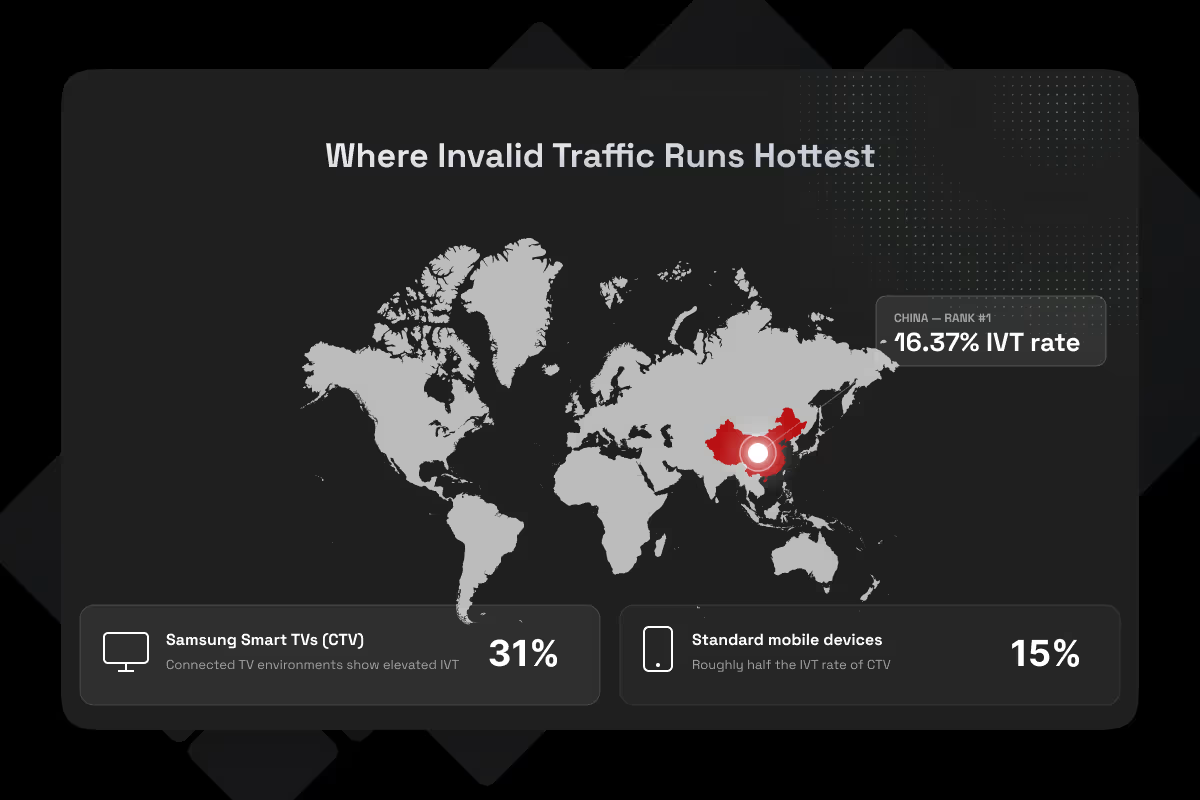
- China ranks number one with a 16.37% IVT rate.
- Mobile and CTV are new targets for fraudsters. Samsung Smart TVs show a 31% higher IVT rate, compared to 15% for standard mobile devices.
- Server-side ad insertion shows an IVT rate 140% higher than the industry average, due to a lack of device-side verification.
- Anti-fraud systems are estimated to recover $47 billion in ad scam losses by 2028.
The programmatic landscape offers efficiency and scale, but its automated nature also creates significant vulnerabilities for exploitation. From the rise of Made-for-Advertising (MFA) sites to the multi-billion dollar cost of domain spoofing, these figures highlight the critical need for transparency in automated ad buying.
Here is a breakdown of the current fraud metrics affecting programmatic platforms:
Mobile and CTV Ad Fraud
In particular, click-driven mobile traffic manipulation is rising. This type of fraudulent impression activity occurs the most across every developed ad market.
- Display Impression Fraud stands as the leading threat for both platforms, occurring at a rate of 33% on Google Play and 28% on the Apple App Store, driven by unnaturally high ad-refresh cycles on single devices.
- Masked IP fraud and Proxy tactics combined account for 21%(Masked IP: 14%, Proxy: 7%) of fraud on Apple and 17% (Masked IP: 10%, Proxy: 7%) on Google, highlighting a higher tendency for Apple-based traffic to utilize location-falsifying intermediaries.
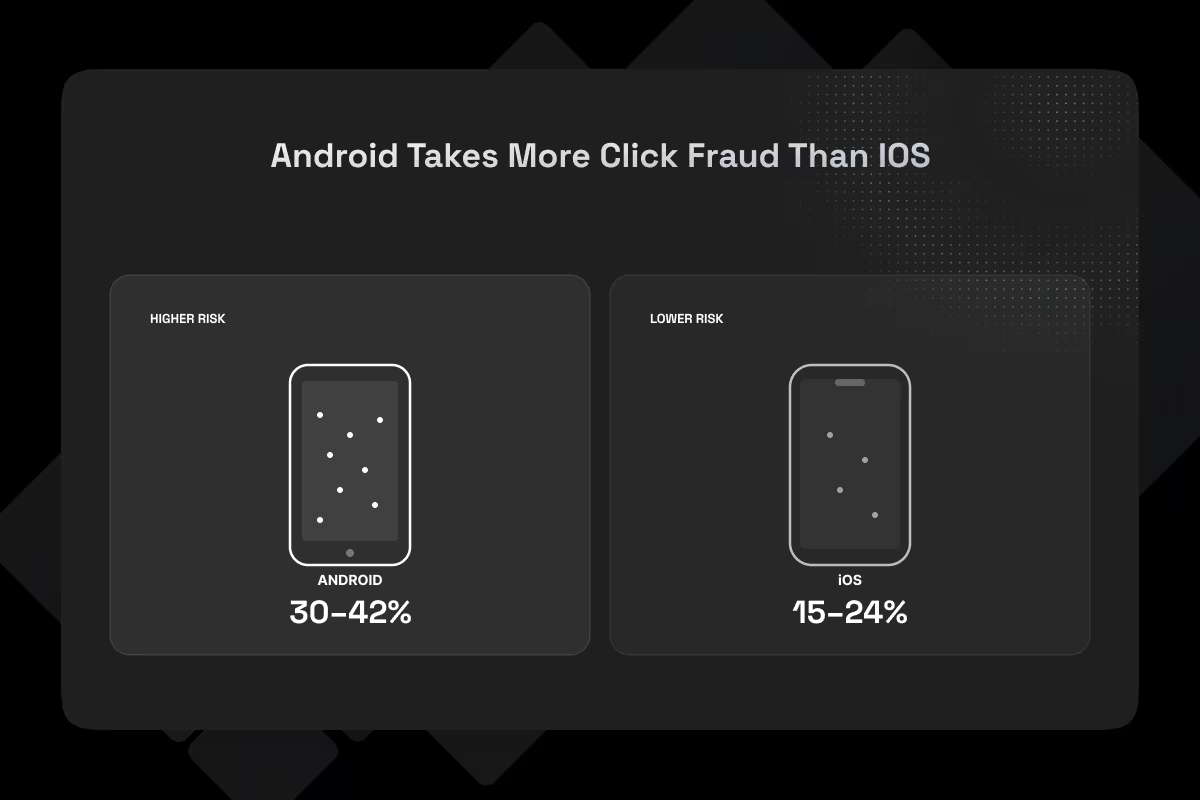
- Android phones face 30-42% click related scams. iOS devices face relatively lower 15-24% click traps.
- Fake click masking attempts will rise by 20% in 2026.
Ad Fraud Breakdown: Device, Region, Browser & OS
Ad Fraud Rate by Device
While it’s a common misconception that fraud is exclusive to mobile environments, the data reveals a more nuanced reality. Desktop environments continue to see the highest rates of invalid traffic, often due to more sophisticated bot nets that mimic human browsing behavior on larger screens. Understanding these fluctuations is essential for cross-platform campaign optimization.
Ad Fraud Rate by Region
Ad fraud is a global issue, but its prevalence varies significantly based on regional market maturity and local cybersecurity regulations. While regions like Europe benefit from stricter privacy and data protections, emerging markets and high-volume hubs in Asia-Pacific present a more challenging landscape for advertisers looking to maintain high-quality traffic.
Ad Fraud Rate by Browser
The choice of browser can be a surprising indicator of traffic quality. Legacy systems and less frequently updated browsers often lack the modern security protocols necessary to filter out advanced IVT. This breakdown highlights the disparity between high-security mobile-first browsers and older web interfaces that remain highly vulnerable to exploitation.
Ad Fraud Rate by Operating System
Just as with browsers, the underlying operating system provides a different level of defense against bot activity. Closed ecosystems often show more resilience, whereas more open or fragmented operating systems particularly those used in older desktop environments or specialized server setups frequently experience higher concentrations of non-human traffic.
Ad Fraud Rate by Platform Different Platforms
Google Ads
As the world’s largest advertising platform, Google Ads is a primary target for sophisticated bot networks. While Google’s internal filters catch a significant portion of invalid traffic, the complexity of its Search Partner and Video networks creates persistent gaps where fraud rates can escalate far beyond the platform average.
Meta Ads
Meta’s fraud landscape is defined by the tension between its highly verified core platforms and its sprawling Audience Network. While overall IVT remains lower than some competitors, the high prevalence of bot accounts and inflated engagement metrics in lead-generation campaigns presents a unique challenge for social media advertisers.
IVT Rate Across All Major Ad Platforms
Not all social and search platforms are created equal when it comes to traffic quality. Disparities in moderation styles, account verification processes, and audience reach mean that a dollar spent on one network may face significantly higher fraud risks than on another, making platform-specific vetting a necessity for modern media buying.
Ad Fraud Risks for Small and Medium Businesses
Research shows that SMBs face ad-spamming and bot attacks more than any other business segment. Startups mostly have low budgets. They focus on quick conversion strategies and allocate the majority of their ad budget toward them.
Why Are SMBs Prime Targets of Advertising Scams?
- Limited budget: Small businesses cannot afford independent, customized AI agents and depend on traditional IP-based blocking systems
- Audit challenge: Highly capable ecosystems even block mixed signals or activities. A portion of these are often genuinely produced by viewers. While larger enterprises can absorb the loss of a niche client segment, the same exposure loss is devastating for small businesses. Industry data shows that most fraud detection solutions carry a 10% to 15% false positive rate. These inaccuracies lead to significant lost revenue and missed opportunities.
- Trust gap: Small business owners take unexplained blocks negatively. They need a transparent report of the cause. Most of them do not feel confident enough using automation.
Common Ad Fraud Risks Faced by SMBs
Cost of Ad Fraud for SMBs
- Persistent losses have forced 12% of the U.S. SMBs to shut down entirely. [Source: SQ magazine]
- 14% of all SMB clicks are from non-genuine sources, indicating the number of fake impressions. [Source: tapper]
- Another report says, every $1 out of $3 of the ad budget is lost because of advertisement frauds.
Industry-Specific Ad Fraud Statistics
High-CPC niches attract significantly more fraud attempts than low-CPC categories. A single fraudulent click in a high-CPC niche yields far greater illicit profit than one in a low-CPC category.
eCommerce and Retail
- Global fraud losses in eCommerce are indeed projected to reach $107 billion by 2029, marking a 141% rise from 2024 levels, according to recent industry analyses.
- Merchant chargeback expenses are expected to exceed $100 billion in 2025, though some reports cite $33.79 billion specifically for eCommerce, with friendly fraud accounting for around 61-75% of disputes.
By January 2025, the landscape of AI-driven traffic was heavily dominated by training crawlers, which represented approximately 90% of all activity. The remaining 10% was attributed to real-time scrapers.
Finance and Insurance
- 43% of digital ad budgets in Fintech are estimated to be lost to fraudulent clicks
- In the financial sector, 42.5% of all detected online fraud attempts come from ad scams.
- According to the report from INTERPOL, AI agents can now automate and execute a complete advertisement fraud project.
- In the finance sector, 73% of the reports are affected by these false ad impressions.
Healthcare and Pharma
Gaming and Entertainment
- 93% of online gamers are abandoning those games where deceptive X buttons appear. [Source: mediapost]
- Rising frauds in ads is harming the gaming industry, too. 84% of gamers instantly uninstall a game when they face any kind of fraud. [Source: pocket gamer]
- To protect iOS gaming budgets, marketers should prioritize defenses against three primary threats: bots and emulators (26%), SDK spoofing (24%), and device farms (22%). Together, these tactics account for nearly three-quarters of fraudulent activity in the sector.
- The iGaming industry saw a significant 64% year-over-year surge in fraudulent activity from 2022 through 2024.
Ad Fraud Detection Trends Shaping 2026
Fraudsters are evolving rapidly, leveraging the latest technology to stay ahead of detection systems. Interactive AI-based environments are successfully blocking a huge portion of the AI-generated ad traps. This has created a new protocol market that is growing rapidly.
AI in Ad Fraud Detection
- AI-integrated fraud detection systems helped businesses recover 40% of their ad-fraud-driven financial losses. [Source: Bayelsa Watch]
- AI advertisement fraud filtering protocols are expected to grow to over $80 billion by 2035 with an astonishing CAGR rate of 18%. [Source: all about AI]
- 81% of businesses adopted AI detection models worldwide. [Source: all about AI]
Industry Standards and Verification
- TAG, MRC, and IAB act as primary auditors in the global fraud detection market. MRC introduced its “Digital Advertising Auction Transparency" to shield programmatic practices. [Source: mediapost]
- TAG-certified channels saved 3.45 billion euros in 2025 for European advertisers. [Source: tagtoday]
- Platforms like Anura, achieved 99.99% accuracy across all types of advertisement fraud detection. This continues, even with this rising AI scam. [Source: anura.io]
- As of 23, April 2026, 47% of the ALEXA top websites are using verified ads.txt files. [Source: adstxt.firstimpression]
Proxy and VPN Traffic as a Fraud Signal
- Residential proxies surpassed 150 million unique IP addresses worldwide in 2026. This volume of IP addresses makes it significantly easier for fraudsters to use them for scams, as they appear genuine. [Source: proxyway]
- More than 70% of click fraud stems from datacenter IPs, VPNs, and proxies, making IP intelligence analysis a critical tool for detection.
- Another report states that bots could corrupt up to 71.5% of website analytics if no VPN filtering is used. [Source: skynet hosting]
- Residential proxy market projected to hit $8.7 billion by 2029, fueling sophisticated fraud.
- Fraudsters rotate IPs from the same subnet for 70+ clicks per IP, mimicking legitimate patterns.
Ad Fraud Spending and the Detection Technology Gap
Both the scammers and the users trying to stop them are now using AI to outsmart each other. A new danger has appeared: cheap bots that act so much like real humans that they are hard to catch. Also, scammers are using new tricks that experts haven't even identified yet.
- Global data signals the ad fraud economy will be more than twice what it is now. Currently, this scam field accounts for a 1 billion dollar economy, which is projected to become over 2.17 billion by 2035. [Source: business research insights]
- 86% of companies spend over 3% of revenues on anti-fraud measures, with 85% reporting increased fraud budgets and 88% expanding fraud teams. 59% of organizations plan to boost anti-fraud technology budgets over the next two years, with only 6% anticipating cuts.
- The digital ad fraud detection market is expected to hit $190 billion by 2030. [Source: Ad ROI market research]
- Small businesses are the largest spending segment for anti-fraud tools to protect their limited ROAS. The spending rate is forecasted to grow by 19.4%. [Source: PS market research]
- 62% of organizations prioritize real-time transaction monitoring, while 76% emphasize AI, machine learning, and analytics for proactive defense.
- The conversion rate of these scams stands at 1.29%. On the flip side, the ratio is 2.54% for legitimate traffic. [Source: IOPEX]
- Europe ranked first in the highest ROI on prevention spending. The region has an IVT ratio of 7.80%. It is the lowest ratio of all regional IVT. [Source: modern diplomacy]
The Detection Technology Gap
- Another report says, less than 40% of AI bot traffic remains undetected. [Source: modern diplomacy]
- 50% of ad scammers use residential IPs to make their footprint undetectable and bypass sophisticated filters. [Source: modern diplomacy]
- Organic channels face most of the fake click attempts. Organic traffic follows a less strict protocol than PPC. [Source: spideraf]
- 52% of detection engineering teams identify data engineering as a top skill gap, limiting data collection, normalization, and integration for robust detections.
- Global cybersecurity workforce roles remain unfilled due to shortages in AI/ML security (34%), cloud security (30%), and zero trust (27%).
- According to DataCamp’s 2024 State of Data Literacy report, there is a staggering 55% gap in workforce readiness: while 83% of leaders view data literacy as essential, only 28% of employees have actually mastered it.
Role of Automation in Ad Fraud Prevention
- Machine learning evolves with new data, spotting spikes or inconsistencies in traffic. AI-driven systems achieve 93% precision and 92% recall in dynamic app analysis, adapting to emerging fraud without rule updates.
- Businesses can now detect 448 invalid clicks per month before they infiltrate the funnel.
- The latest real-time fraud blocking systems now process detection 35% faster than previous generations. [Source: researchgate]
- AI-automated IVT detection tools can identify unnatural traffic 300% faster than traditional tools. [Source: skyquestt]
- Advanced AI-integrated tracking systems have reduced false positive signals by 85%. [Source: MasterCard]
- Organizations using AI-automated filtering services reported 530% ROI compared to the cost of the software. [Source: fraudblocker]
Key Takeaways from Ad Fraud Statistics
In short, ad fraud technologies are advancing in parallel with detection systems. Fraudsters are developing increasingly complex tactics to bypass filters more subtly. Countermeasures are also growing exponentially to eliminate them.
Large enterprises are more successful in implementing elite detection protocols. Small businesses are falling behind mostly due to a lack of resources and budget. Fraudsters launch the majority of attacks using residential IP addresses to evade detection.
This masking trick makes these guards almost undetectable. Major ad platforms are still inadvertently routing a significant share of traffic through fraudulent placements.
What the Data Tells Us
A recent report from Opticks Security suggests that affiliate and programmatic channels face the most deceptive ads (14.3% and 12.2%, respectively). SEM ad channels pose 2% risk of fraudulent ads, whereas native channels show 2.6%.
This table illustrates the current ad market comparison of fraud and block tech industries:
What Businesses Should Focus On
- Implement real-time ad fraud detection: No other technologies are as effective in detecting AI ad scams as AI-based filtering environments. Use advanced real-time trackers if possible.
- Verify traffic sources: Often, highly interactive blockers instantly block mixed signals the moment they detect them. These systems do this so that scammers can't infiltrate the natural user funnel. This may lead to considerable traffic loss for new businesses.
- Use proxies: To maintain a certain account persona and continue your competitor research, proxies offer the best convenience.
- Audit the supply path: Audit the supply path: Use Supply Path Optimization (SPO) to reduce unnecessary intermediaries between your ad buy and the publisher, ensuring your budget reaches verified, brand-safe inventory.
- Follow the whitelist: Always maintain an updated whitelist of where you found your ads generated a generous amount of genuine conversions.
- Monitor real-time performance: Be aware of sudden CTR spikes. CAPTCHA challenges and behavioral biometrics can filter a significant number of automated bot submissions from the outset.
- In-app branding: Browser-based bots are unable to blend into app-based advertisements. Place your ads through the app platforms to gain genuine traffic.
How Proxies Help in Ad Fraud Prevention and Research
Proxies act as your trust guarantor to highly interactive algorithms of ad platforms, like Google or Bing Ads. They represent you as a genuine advertiser. As a bonus, you can work for multiple niches at the same time without facing suspicious penalties or account bans.
Role of Proxies in Ad Verification
A proxy ecosystem saves you in three ways:
- Checking ads: Proxies allow you to view your own advertisements exactly as a local user would, across different regions, without alerting competitors or triggering platform anomaly flags.
- Shielding from detecting location inconsistencies: Google, Bing, and other search engines now follow strict AI optimization policies to prevent fraud. As a marketer, your proxy saves your account during targeted geo-detection. The platform registers your account as a unique persona tied to the listed region. These platforms see you as a genuine advertiser, not as an irrelevant traffic producer.
- Validating ad placements without detection: An AI-backed algorithm consistently monitors your digital footprints. This is why any ID gets flagged easily; even slightly inconsistent behavior gets noticed. While competitor analysis is crucial, you can utilize your account for your niche. This shows you as a conscious researcher who is trying to stay updated about the field. Your trust score improves quickly, leading to fast ad approval.
Proxies for Safe Competitive and Traffic Research
- Scraping ad data without triggering blocks: Major platforms, especially Google's algorithms, trace ads region to ensure your account is a real one. A genuine IP shows your address in a certain city in a country. It appears more localized, evading blocks.
- Monitoring competitor ad activity: Platform-specific crawlers approve accounts that operate under a trusted regional IP address. As a result, the algorithm consistently sends you relevant posts and industry updates. It becomes easier for you to collect info when your algorithm is trained and informed about your interests. You see big brands and their activity, which helps you shape yours.
Why Businesses Use Floxy Proxies
Floxy specializes in creating a customized IP environment that mimics human browsing behavior. Because agencies require a massive IP pool to manage diverse client portfolios, Floxy provides clean residential IPs to ensure high deliverability and trust.
Unlike average proxy providers, Floxy's solution connects quickly. They offer proxy solutions for data centers, mobile, and even ISPs. Such flexibility allows businesses to monitor real-time data at a reasonable rate.
Conclusion
Ad fraud statistics are a valuable asset for any seasoned branding professional. To build a future-proof regional branding strategy, this data helps you figure out trusted publishers.
Specific industries can save their ad budget without spending deliberately for “average fit” solutions. Instead, they can take targeted initiatives to develop a sustainable ecosystem.
Still, proxy solutions shield your campaign from ad manipulation from the start. Tested providers, such as Floxy.io, excel at designing a customized spam-proof proxy system.
When verification is crucial, such an ecosystem offers reliable security. Your campaign testing and the overall setup appear more reliable to the platform, preventing click spam effectively.
In competitive marketing, solid statistics matter to create a sustainable branding plan. Remember, your strategy is the key driver of strong brand value. We research and serve the data that matters so you can plan better. For more updates, subscribe to our newsletter.