Table of Contents
The AI industry is scaling faster than any technology in history. Yet every high-performing model shares one non-negotiable prerequisite: high-quality, structured data. Algorithms do not generate intelligence; they extract patterns from what they are trained on. AI data collection is not a technical step; it is the strategic foundation.
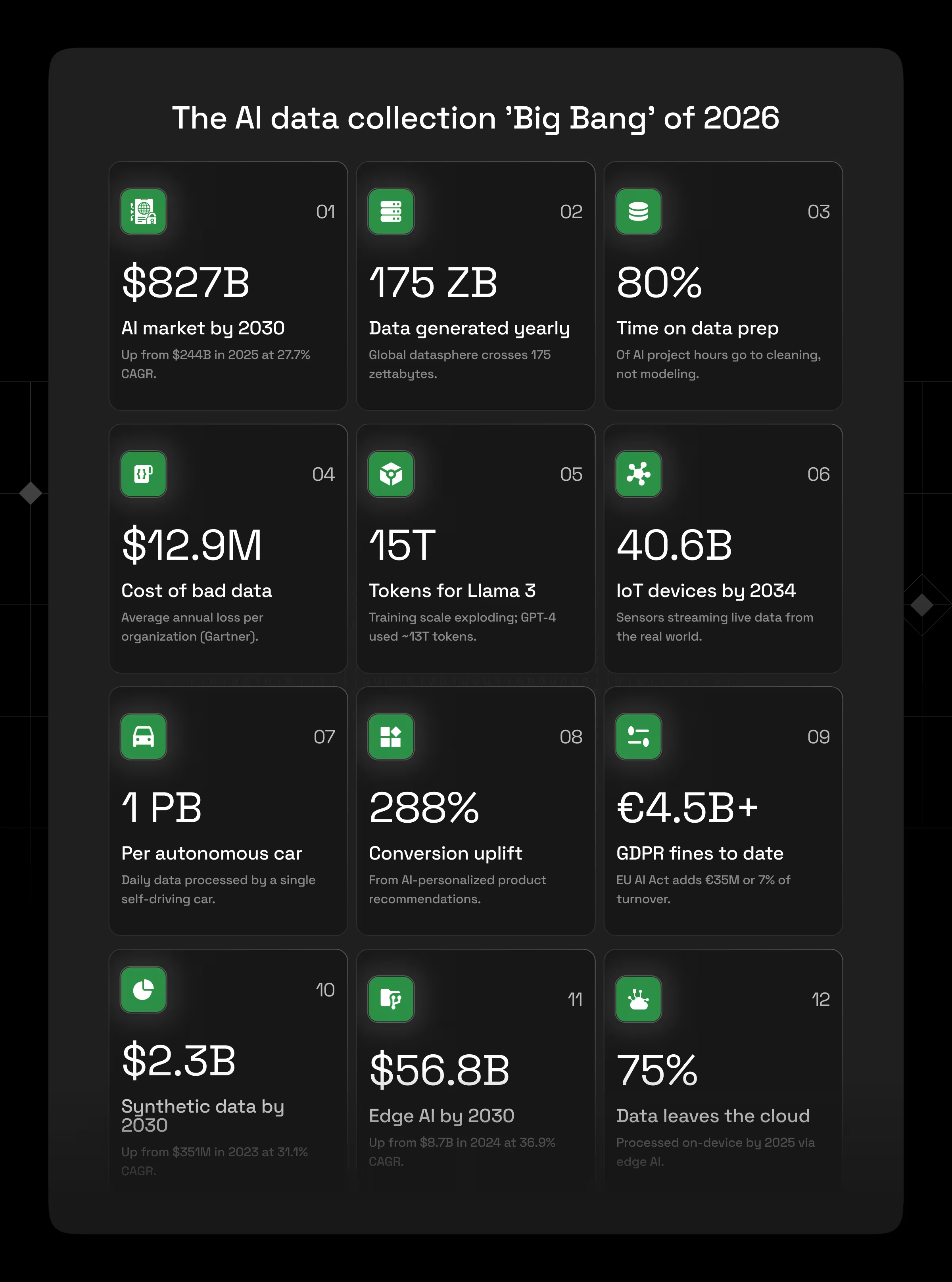
Teams now dedicate 80% of an AI project's total time to data preparation and collection. The takeaway is clear: better data leads to better AI.
Modern AI systems rely on multiple data sources. However, artificial intelligence data is not just about quantity; it must meet strict standards of quality, relevance, and ethical use. Bad/poor data can lead to biased outcomes, inaccurate predictions, and loss of trust.
In this guide, we answer the question most teams overlook: how does AI collect data, and what does it take to do it well? We cover methods, trends, tools, and best practices so you can build smarter and more reliable AI systems.
Understanding AI Data Collection: Why It Matters
Powerful algorithms alone are not enough to build effective AI systems. You need to understand how teams collect, process, and use data.
Many AI projects fail not because of weak models, but because of poor data quality or incomplete datasets. That’s why understanding the data gathering process can help businesses train better models, reduce risks, and avoid costly mistakes.
The global AI landscape is experiencing an extraordinary surge, with the total market value climbing from $244 billion in 2025 toward a projected $827 billion by 2030, sustained by a robust annual growth rate of 27.7%, says another source.
AI Market Growth Table
Here's the market size data formatted as a clear table for 2025–2030.
This momentum is particularly visible in Europe, where the market is expected to leap from €42.6 billion to over €190 billion within the same timeframe. A significant driver of this expansion is Generative AI; after reaching $33.9 billion in 2024, it is on track to claim 33% of all AI software spending by 2027.
This rapid adoption is reflected in local business sectors, where 32% of German companies now utilize AI tools and one-third of UK marketers have successfully integrated the technology into their workflows.
The Current State of Artificial Intelligence Data
AI is expanding rapidly across industries, and so is the volume of data required to power it.
Analysts expect the global AI market to reach over $1.3 trillion by 2030. This reflects massive adoption across sectors. At the same time, the world is generating over 175 zettabytes of data annually, and companies can use much of it to train AI systems.
However, not all data is equally useful. Structured data (organized in tables and databases) is easier for AI models to process. However, data scientists spend almost 80% of their time cleaning and preparing data.
Proxy networks like Floxy reduce this problem by routing requests through clean, rotating IPs that return consistent, location-accurate data from the start, meaning less noise enters the pipeline before cleaning even begins.
Why Businesses Rely on High-Quality Data Collection for AI
High-quality data is the difference between an AI system that works and one that fails.
Improving Model Accuracy and Reliability
- Clean, labeled data helps AI models learn patterns more accurately.
- Poor-quality data leads to wrong predictions and inconsistent outputs.
Reducing Hallucinations and Algorithmic Errors
- In generative AI, low-quality or biased data can cause hallucinations (false or misleading outputs).
- High-quality datasets reduce these risks and improve trustworthiness.
- According to Gartner, bad data costs organizations an average of $12.9 million annually.
Scaling AI Operations Efficiently
Well-structured data pipelines allow businesses to:
- Train models faster.
- Deploy AI at scale.
- Continuously improve performance.
Takeaway
- AI growth is driving massive demand for data.
- Most available data is unstructured and complex.
- High-quality data collection directly impacts accuracy, reliability, and scalability.
In simple terms: Better data → Better AI outcomes
How Does AI Collect Data? Key Methods and Sources
AI systems don't just 'know' things; they learn from data that multiple channels supply. Understanding these sources helps businesses design better data pipelines and ensure their AI models are accurate, relevant, and up to date.
Web Scraping and Crawling
Web scraping is one of the most common methods of AI data collection. AI automatically extracts data from publicly available websites.
AI systems can collect:
- Text (articles, reviews, blogs)
- Images and videos
- Product pricing and listings
This method is widely used for:
- Market research and competitor analysis
- Sentiment analysis from reviews and social media
- Training language and vision models
For example, developers often train large AI models on massive public datasets like Common Crawl, which contains petabytes of web data collected over the years.
User Inputs and Interactions
A major source of AI data comes directly from users. Every user interaction with these platforms generates valuable training data:
- Chatbots
- Voice assistants
- Search engines
- Mobile apps
Google processes billions of searches daily, each contributing behavioral data that improves AI systems.
AI systems track:
- Clicks and navigation patterns
- Time spent on content
- User preferences and feedback
Developers often call this telemetry data, and it helps AI systems:
- Personalize experiences
- Improve recommendations
- Learn from real user behavior
Sensors, IoT, and APIs
Real-time data from the physical world increasingly powers AI.
Sensors and IoT Devices
Smart devices collect continuous data such as:
- Location (GPS)
- Temperature and environment
- Movement and biometrics
Analysts expect around 40.6 billion IoT devices globally by 2034, generating massive real-time datasets.
APIs (Application Programming Interfaces)
APIs allow systems to pull structured data directly from other platforms, such as:
- Payment systems
- Social media platforms
- Weather or mapping services
This enables real-time data pipelines, which are essential for:
- Fraud detection
- Recommendation engines
- Predictive analytics
Takeaway
AI collects data from multiple sources simultaneously. Key methods include:
- Web scraping (public data).
- User interactions (behavioral data).
- Sensors & APIs (real-time data).
Each source plays a different role, but together, they power modern intelligent systems.
So, the answer to your question of how does AI collect data? Through the web, through users, and through the real world, all running simultaneously.
How Does the AI Data Pipeline Work?
Most people assume the algorithm is the hardest part of AI. It is not. The real challenge is everything that happens to data before the algorithm ever sees it.
Understanding AI data collection is a good starting point. However, that only tells half the story. Raw data cannot train a model on its own, no matter how large the volume.
Instead, data must travel through a structured AI data pipeline. This is a sequence of stages that cleans, organizes, and shapes the information. This process turns data into something a machine can actually learn from.
Getting data collection for AI right is the deciding factor for businesses. It separates those building reliable models from those wasting budgets on tools that do not work.
What Exactly Is an AI Data Pipeline?
A data pipeline for machine learning is best understood as an assembly line for data. Unrefined, messy information enters one end. Clean, structured, model-ready datasets come out the other.
The data lifecycle in AI moves through five core stages:
- Data Ingestion
- Data Transformation and Feature Engineering
- Data Storage
- Model Training and Inference
- Monitoring and Feedback Loops
None of these stages are optional. If you rush one, the problem does not disappear. Instead, it shows up later as a model that performs poorly in the real world.
Stage 1: Data Ingestion
Every pipeline starts here. Data gets pulled from all relevant sources at once. This includes databases, APIs, IoT devices, scraped websites, and third-party datasets.
This can happen in two ways. Batch ingestion runs on scheduled intervals. Streaming ingestion pulls data in real time.
What trips up most teams at this stage is the sheer diversity of sources. Customer data might live in a CRM system. Transaction data sits in a billing platform. Behavioral data lives in web analytics. Each source has different formats, update frequencies, and connectivity requirements.
The priority here is building an ingestion layer that absorbs all of this without forcing downstream stages to deal with the inconsistency.
Stage 2: Data Transformation and Feature Engineering
This is where things get messy, literally. Real-world data is almost never clean. It arrives with duplicate records, missing values, inconsistent formats, and noise that would confuse any model trained on it. Data preprocessing in machine learning is the process of fixing these issues before they cause problems downstream.
This is also the most time-consuming part of the entire ETL pipeline for AI. Teams routinely spend up to 80% of their total project time here. Because of this, experienced teams invest heavily in automation and tooling from the start.
Once data is clean, feature engineering begins. This is where the AI data collection process diverges most significantly from traditional data work.
Feature engineering decides which variables a model actually learns from and how those variables are shaped. Raw data rarely arrives in a form that models find useful. A timestamp means very little on its own.
However, transform it into "time since the last transaction" or "number of logins in the past 24 hours," and suddenly it becomes a powerful signal for fraud detection.
This is also where data labeling for AI plays a critical role. A model looking at thousands of images has no idea what it sees unless someone tells it.
Data labeling adds that context by tagging raw data so models can learn from it. An image gets labeled as a "cat" or "dog." A customer review gets flagged as "positive" or "negative." A frame of dashcam footage gets annotated with the location of every pedestrian and vehicle.
Companies rely on data annotation tools to manage this work at scale. These tools combine automated suggestions with human review, helping teams handle large annotation workloads without sacrificing accuracy.
Stage 3: Data Storage
Processed, transformed, and feature-rich data still needs somewhere to live. How you store it matters more than most people expect.
Depending on the use case, teams work with three main options:
- Data lakes handle large volumes of unstructured data.
- Data warehouses are for structured, query-ready datasets.
- Vector databases support AI-specific applications like semantic search and generative AI.
Getting storage architecture right ensures your data pipeline for machine learning stays fast and scalable as datasets grow from gigabytes into terabytes and beyond. Dataset versioning matters here too. When you retrain a model, you need to know exactly which version of the data and features were used.
Stage 4: Model Training and Inference
This is where the prepared data finally meets the algorithm.
Understanding the difference between a training dataset vs testing dataset is not just a technicality. It is fundamental to whether you can trust your model in the real world.
Data is typically split into three parts:
- Training dataset: This is what the model learns from. It usually makes up 70% to 80% of the total data.
- Validation dataset: This is used during training to tune parameters and catch overfitting early.
- Testing dataset: This contains data the model has never seen. It is used to evaluate real-world performance honestly.
Mixing training and testing data is one of the most common and costly mistakes teams make. Models that train and test on overlapping data look great in development. However, they fall apart the moment they meet reality.
Stage 5: Monitoring and Feedback Loops
Most teams treat deployment as the finish line. It is not. It is where the real work begins.
Once a model is live, its performance needs continuous monitoring across three layers:
- Data layer: Tracks whether incoming data is still healthy, complete, and consistent with what the model was trained on.
- Feature layer: Ensures features are computed the same way in production as they were during training. Drift here is one of the most common silent killers of model accuracy.
- Prediction layer: Tracks whether the model's outputs are still accurate, well-calibrated, and fair across different user segments.
Without this feedback loop, models degrade silently over time. The business keeps relying on predictions that no longer reflect reality.
Takeaway
The AI data collection process does not stop when you gather data. It runs through a full pipeline where each stage builds directly on the previous one.
Weak transformation leads to noisy training data. Poor annotation leads to mislabeled examples. Sloppy train/test splits produce models you cannot trust in production. And skipping monitoring means you will not know when things go wrong until it is too late.
Get the pipeline right, and the model has a genuine chance to perform. Skip the steps, and even the most sophisticated algorithm will struggle.
TL;DR: data collection opens the door. A well-built AI data pipeline is what actually walks you through it.
Key Types of Artificial Intelligence Data Businesses Need
AI data can feel complex. But at its core, it falls into a few clear categories. Breaking it down this way helps businesses choose the right data for the right use case and build more effective AI systems.
Text and Language Data
Text data is the backbone of many modern AI systems, especially Large Language Models (LLMs).
It includes:
- Articles, books, and web pages
- Customer reviews and support chats
- Emails and social media content
This type of data powers:
- Natural Language Processing (NLP)
- Chatbots and virtual assistants
- Sentiment analysis and content generation
Models like GPT are trained on vast amounts of text data to understand and generate human-like language.
Modern AI models demand an immense scale of information. For context, GPT-4 trained on roughly 13 trillion tokens of text, and Meta’s Llama 3 surpassed that with approximately 15 trillion tokens. These massive requirements have turned high-quality, scalable text data collection into a critical strategic priority for any organization developing competitive AI.
According to the research report “Global Natural Language Processing (NLP) Market Outlook, 2030", the global Natural Language Processing (NLP) market is projected to reach a market size of USD 54.29 billion by 2030, increasing from USD 38.60 billion in 2024.
NLP Market Overview
Image and Video Data
Visual data is essential for AI systems that “see” and interpret the world.
It includes:
- Photos and videos
- Medical imaging (X-rays, MRIs)
- Surveillance and satellite footage
This data is used in:
- Computer vision models
- Object detection and image classification
- Facial recognition systems
- Autonomous vehicles
Analysts project the global computer vision market will reach over $58.29 billion by 2030.
Market Size Forecast Table
Here's the provided market data formatted as a clear table.
Audio and Speech Data
Audio data enables AI systems to hear, understand, and respond to spoken language.
It includes:
- Voice recordings
- Call center conversations
- Podcasts and media content
This data powers:
- Speech recognition systems
- Voice assistants
- Real-time translation tools
The speech recognition market is growing rapidly and will exceed USD 53.67 billion by 2030.
Takeaway
AI relies on three core data types:
- Text → understanding language
- Images & video → understanding visuals
- Audio → understanding speech
Each type plays a unique role in building intelligent systems.
Simply put, the more diverse and high-quality the data, the smarter the AI becomes.
Industry-Specific AI Data Collection Use Cases
AI data collection is not one-size-fits-all. Different industries rely on different types of data, tools, and compliance standards depending on their goals. Understanding these variations will help you design more effective and secure AI systems.
Healthcare and Medicine
Healthcare is one of the most data-sensitive industries, where accuracy and privacy are critical.
AI systems collect:
- Medical imaging (X-rays, MRIs, CT scans)
- Electronic health records (EHRs)
- Clinical trial data
This data is used to:
- Train predictive diagnostic models
- Detect diseases earlier (e.g., cancer detection)
- Personalize treatment plans
According to a study published by the National Institutes of Health (NIH), AI models trained on medical imaging data have shown performance comparable to human experts in certain diagnostic tasks.
However, strict privacy standards require:
- Data anonymization
- Secure storage and access controls
Finance and e-commerce
AI relies heavily on behavioral and transactional data in finance and online retail.
Key data sources include:
- Transaction histories
- Payment patterns
- Customer browsing and purchase behavior
This data powers:
- Fraud detection systems
- Credit risk assessment models
- Personalized recommendation engines
Companies excelling at personalization generate 40% more revenue. Personalization typically drives a 10-15% revenue lift, with top performers achieving 25%+. Meanwhile, product recommendations alone account for 31% of total eCommerce site revenues.
Supporting Statistics
Conversion Rates: Personalized recommendations can increase conversion rates by 288% (Envive Insights).
Automotive and Manufacturing
These industries rely on real-world, real-time data from machines and environments.
Automotive (Self-Driving Cars)
AI systems collect:
- Camera footage
- LiDAR and radar data
- GPS and environmental data
Autonomous vehicles process 1 petabytes of data daily to make driving decisions.
Manufacturing (Smart Factories)
Smart factories collect data from:
- Machine sensors
- Production lines
- Equipment performance logs
This enables:
- Predictive maintenance (fixing machines before failure)
- Process optimization
- Reduced downtime
Takeaway
AI data collection varies significantly by industry:
- Healthcare → sensitive, regulated data
- Finance & e-commerce → behavioral and transactional data
- Automotive & manufacturing → real-time sensor data
In simple terms, the type of data you collect depends on the problem you're trying to solve.
Data Collection Trends Shaping 2026
AI continues to evolve, and so does data collection. Businesses are moving beyond traditional methods and adopting smarter, faster, and more privacy-conscious approaches. These trends are shaping how businesses train and deploy AI systems in 2026 and beyond.
Synthetic Data Generation
One of the biggest shifts in AI data collection is the rise of synthetic data. This is artificially generated data that mimics real-world patterns.
Synthetic data is used to:
- Fill gaps where real data is limited
- Simulate rare scenarios (e.g., accidents in autonomous driving)
- Protect sensitive information
The synthetic data market is growing rapidly as organizations seek privacy-safe alternatives to real-world data.
Gartner predicts synthetic data will surpass real data in AI model training by 2030, with the market growing from $351.2 million in 2023 to USD 2,339.8 million by 2030, at a CAGR of 31.1%. Synthetic data is especially useful in regulated industries like healthcare and finance.
Crowdsourcing and Human-in-the-Loop (HITL)
AI is powerful, but human input is still essential. This is especially true for accuracy and ethical alignment.
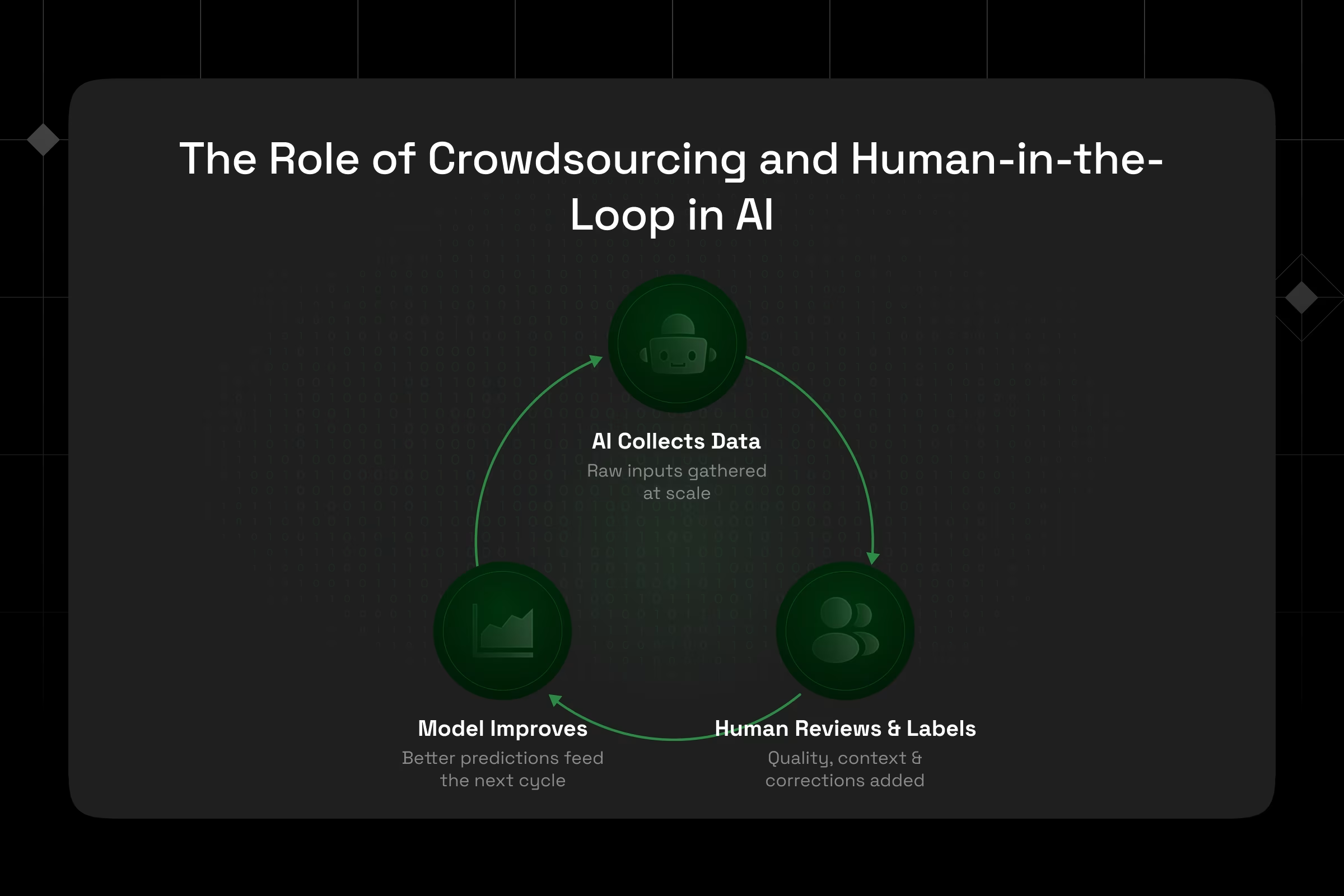
Human-in-the-Loop (HITL) combines:
- Automated data collection (e.g., scraping)
- Human review and annotation
This approach is widely used for:
- Labeling images, text, and audio
- Training conversational AI systems
- Improving model outputs with feedback
Edge AI Data Processing
Another major trend is shifting data collection closer to the source, known as edge AI. Instead of sending all data to the cloud, AI systems now:
- Collect and process data locally on devices (e.g., smartphones, IoT devices)
- Make real-time decisions without relying on servers
Analysts project the edge AI market will exceed $100 billion by 2030, driven by demand for faster and more efficient processing.
Market Projections & Growth
- Market Valuation (2024): $8.7 billion (Base Year)
- Market Valuation (2025): $11.8 billion
- Market Valuation (2030): $56.8 billion (Projected)
- Growth Rate: 36.9% CAGR (2025–2030)
- Data Processing Shift: Estimated 75% of data to be processed outside traditional data centers or the cloud by 2025. [Source: Globenewswire]
Market Segmentation & Dominance
- Dominant Segment: Hardware (held the largest share in 2024 and is expected to maintain dominance through 2030).
- Leading Region: North America (highest market share as of 2024; projected to remain the leader through 2030).
Key Market Drivers
- Real-Time Transmission: Necessity for low-latency processing in autonomous vehicles and smart surveillance.
- IoT & Robotics: Rising demand for on-device intelligence to reduce cloud dependency and increase operational efficiency.
- Technological Maturity: Advances in AI/ML algorithms and hardware efficiency allowing complex models to run on-device.
Benefits include:
- Lower latency (faster responses)
- Reduced bandwidth usage
- Improved data privacy
Takeaway
AI data collection is becoming more advanced and privacy-aware. Key trends shaping 2026 include:
- Synthetic data (scalable and safe)
- Human-in-the-loop (accurate and ethical)
- Edge AI (fast and efficient)
The future of AI data collection is smarter, safer, and closer to the source.
How Proxies Help in AI Data Collection and Protection
As businesses scale data collection for AI, infrastructure becomes just as important as the data itself. When gathering large volumes of data, especially through web scraping, companies need tools that ensure speed, reliability, and anonymity. This is where proxies play a critical role.
Role of Proxies in Web Scraping for AI
Proxies act as intermediaries between your system and the internet. They help you collect data more efficiently and safely. They help with:
Masking IP addresses
- When scraping websites at scale, repeated requests from a single IP can trigger blocks.
- Proxies rotate IP addresses, making requests appear as if they come from different users.
Bypassing geo-restrictions
- Many websites show different data based on location (pricing, availability, content).
- Proxies allow access to region-specific data, helping build more diverse and unbiased datasets.
Studies show that most large-scale web scraping operations rely on residential proxy networks to avoid detection and ensure continuity.
Proxies for Secure and Continuous Data Gathering
Beyond access, proxies also help maintain stable and secure data pipelines:
Avoiding CAPTCHA and rate limits
- Websites often limit repeated requests to prevent bots.
- Rotating proxies distribute requests across multiple IPs, reducing the chance of triggering security systems.
Ensuring continuous data collection
- Proxies help maintain uptime for long-running scraping tasks.
- This is essential for AI systems that rely on real-time or frequently updated data.
Protecting internal networks
By routing traffic through external proxy servers, companies avoid exposing their internal infrastructure.
Why Businesses Use Floxy Proxies
If your business is building large-scale AI systems, choosing the right proxy provider is crucial. Floxy specializes in high-performance data collection.
Reliability and high uptime
Floxy ensures uninterrupted scraping, even during large-scale operations.
Speed and performance
- Fast proxy networks reduce latency, allowing quicker data extraction.
- This is critical when collecting millions of data points.
Scalability
- Floxy supports large volumes of requests across multiple locations.
- It is ideal for building massive AI training datasets.
Takeaway
Using a good and secure proxy server is a core part of modern AI data collection infrastructure. It can help with:
- Anonymity and IP protection
- Access to global data
- Stable, uninterrupted scraping
Proxies help you collect data securely, efficiently, and at scale.
Challenges in Data Collection for AI: What Are the Risks?
Collecting data for AI may sound straightforward. But in reality, it comes with serious challenges and risks. From legal issues to data quality problems, businesses must carefully manage how they gather and use data. Otherwise, even the best AI models can fail.
Corrupted or tampered data introduces an even more serious threat known as model poisoning, where intentionally bad data causes an AI to learn incorrect patterns and behave unpredictably once deployed.
Adversarial data attacks follow a similar logic, where bad actors subtly manipulate input data to fool AI models into making wrong decisions, often without triggering any visible warning.
Data Privacy and Compliance Concerns
One of the biggest challenges in AI data collection is staying compliant with evolving privacy laws. Regulations like the General Data Protection Regulation (GDPR) and the California Consumer Privacy Act (CCPA) require businesses to:
- Obtain clear user consent
- Limit how personal data is collected and used
- Ensure secure data storage
Mishandling personal data can be costly. GDPR fines alone have exceeded €4.5 billion since 2018. Data leaks compound this risk further. A single breach can expose entire training datasets, compromise user privacy, and trigger regulatory investigations at the same time.
The EU AI Act reached full enforcement for high-risk systems in August 2026, marking the world's first comprehensive set of AI regulations. This law adds a new penalty layer where violations cost businesses up to €35 million or 7% of their global turnover. Companies collecting data to train high-risk AI models must now satisfy both GDPR and EU AI Act requirements at the same time.
GDPR Fines Summary Table
Here's a concise table summarizing the key GDPR fines data from DLA Piper's eighth annual survey:
Overcoming Data Bias
AI systems are only as fair as the data that trains them. If datasets are not diverse or representative, AI models can produce biased or unfair outcomes.
This can affect:
- Hiring algorithms
- Loan approvals
- Facial recognition systems
According to research from the National Institute of Standards and Technology (NIST), some facial recognition systems showed higher error rates for certain demographic groups.
Data Quality, Cleaning, and Annotation
Even when data is available, it is rarely ready to use.
Raw data often contains:
- Missing values
- Duplicates
- Inconsistent formats
Cleaning and preparing data is time-consuming. As mentioned earlier, teams spend up to 80% of AI project time on data preparation.
Data annotation (labeling images, text, etc.) is another major challenge:
- It often requires manual effort.
- It can be expensive and prone to human error.
Poor-quality data has real costs. Organizations lose an average of $12.9 million annually due to poor data quality.
Takeaway
AI data collection comes with legal, ethical, and technical challenges. Key risks include:
- Privacy and compliance issues
- Data bias and fairness concerns
- Poor data quality and high preparation costs
Collecting data is easy. Collecting the right data responsibly is the real challenge.
Conclusion
AI is only as powerful as the data behind it. Throughout this guide, we’ve seen how different methods, such as web scraping, user interactions, sensors, and APIs, feed modern AI systems, and how various data types like text, images, and audio power different use cases.
However, data collection for AI comes with real challenges, from privacy regulations to data quality and bias. Addressing them requires investing in the right infrastructure, including a reliable proxy solution like Floxy that protects your data pipelines and ensures collection continuity.
Mastering the AI data collection will allow your business to build more accurate, reliable, and scalable machine learning models. At the same time, staying compliant with regulations and focusing on ethical data use is crucial for long-term success.
The bottom line: better data practices lead to better AI outcomes and stronger trust.